Compliance · Human-in-the-loop
The machine does the work.A human makes the call.
Human-in-the-loop is not a setting in Talara. It is how the platform is built: a person owns every consequential decision.
What is human-in-the-loop hiring?
Human-in-the-loop hiring means a person stays responsible for every consequential decision even when software does the work leading up to it. In Talara, no candidate advances, no offer sends, and no role closes without a recorded human approval; the gate is a database constraint, not an optional setting.
The human is the point, not the checkpoint.
Most hiring AI treats the person as a gate the workflow has to get through. Talara is built the other way around: the workflow exists to clear what stands between a recruiter and the human part of the job. Tally drafts the roles, runs the sourcing passes, reads the inbound, proposes the slots, prepares the scorecards, assembles the offers. What reaches you is not a task queue. It’s a prepared decision, with the reasoning attached.
Approvals are where your judgment goes to work.
A person clicking “approve” on whatever the machine says isn’t oversight. It’s a rubber stamp, and regulators say so too. That’s why nothing in Talara arrives as a bare yes or no. Every gated decision carries the score, the confidence, the reasoning, and the before-and-after. You’re not auditing the machine’s work; you’re directing it, the same judgment you’d bring to a debrief, applied at the exact moment it moves a candidate.
The hours go back where they belong.
- What Tally absorbs: the drafting, the calendar tennis, the screening summaries, the follow-ups, the paperwork: the waiting.
- What you get back: the first real conversation with a candidate. The debrief where the team actually decides. The closing call that lands an offer. The relationships that make someone say yes.
The agent absorbs the busywork. You absorb only the decisions.
This is the bridge to what recruiting becomes next.
Recruiting operations are moving from operating software to directing agents in plain language: ask for an outcome, approve the steps that matter. Human-in-the-loop isn’t the brake on that future. It’s what makes it safe to walk into. And the gate travels everywhere the agent works: the app, your inbox, even a Claude conversation over MCP. Wherever the work runs, a person opens the gate, and the decision is written down.
Also what the law asks for.
The EU AI Act classifies hiring AI as high-risk and requires genuine human oversight: a person in the loop before the action, not watching from beside it. Talara’s model satisfies that structurally: the gate is a database constraint, every approval is a named person’s recorded decision.
What stays human, what the AI does
Tally does the work: drafting roles, sourcing, screening, scheduling, summarizing, and preparing offers.
You make the calls: who advances, what an offer says, when it sends, and whether a role closes. That division is the whole point of an agentic ATS.
FAQ
Questions, answered.
What is human-in-the-loop AI?
Does human-in-the-loop slow hiring down?
What’s the difference between human-in-the-loop and human-on-the-loop?
Is human-in-the-loop legally required for hiring AI?
In the product
Who can open the gate is a setting you own.
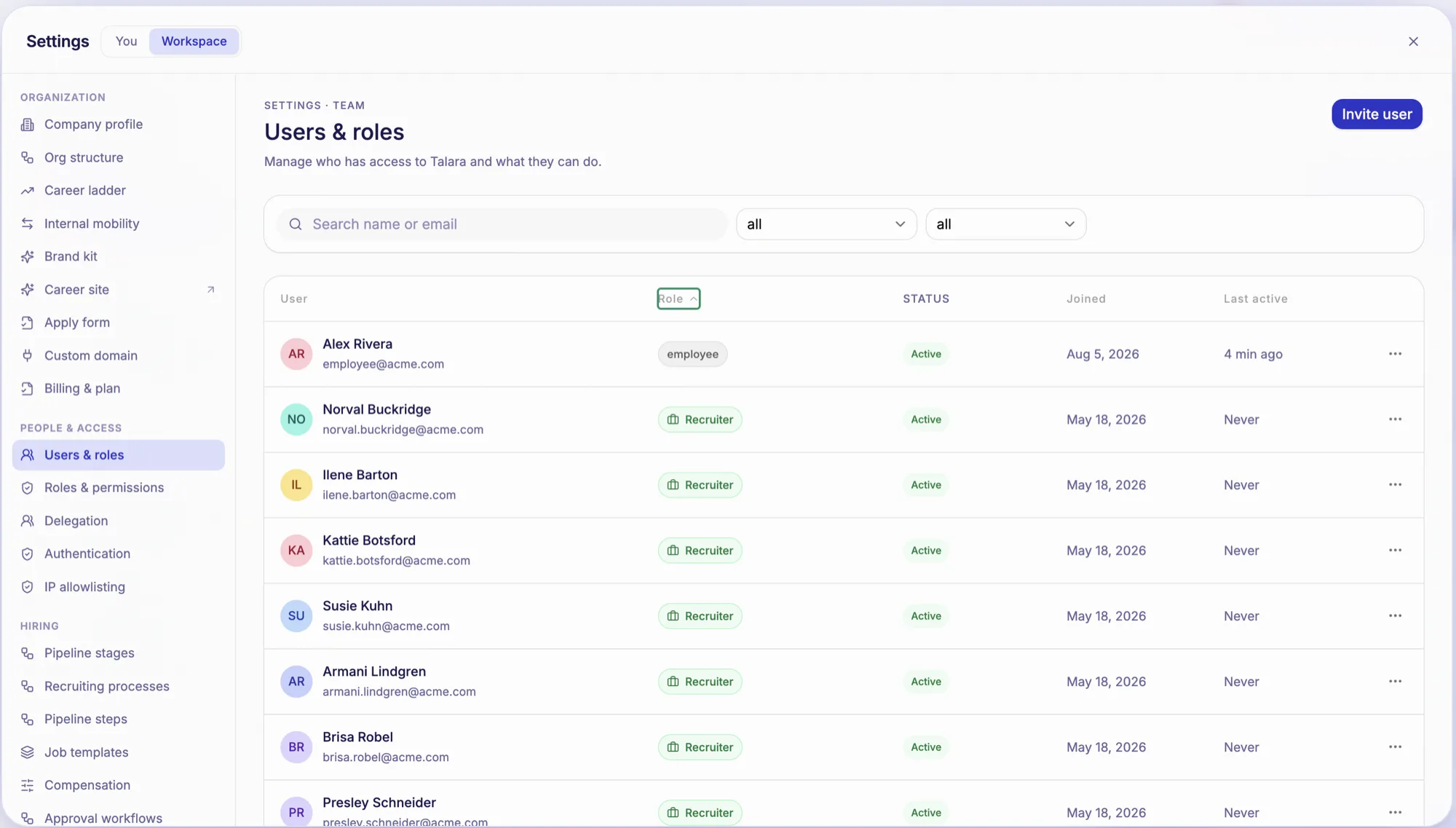
Roles, delegation and approval workflows are configured per workspace, so the chain matches how your organisation separates duties. The gate itself is not optional; who is allowed to open it is.
The work, automated.The decisions, yours.
See human-in-the-loop in your own pipeline.